
Votive Candles
1. Introduction
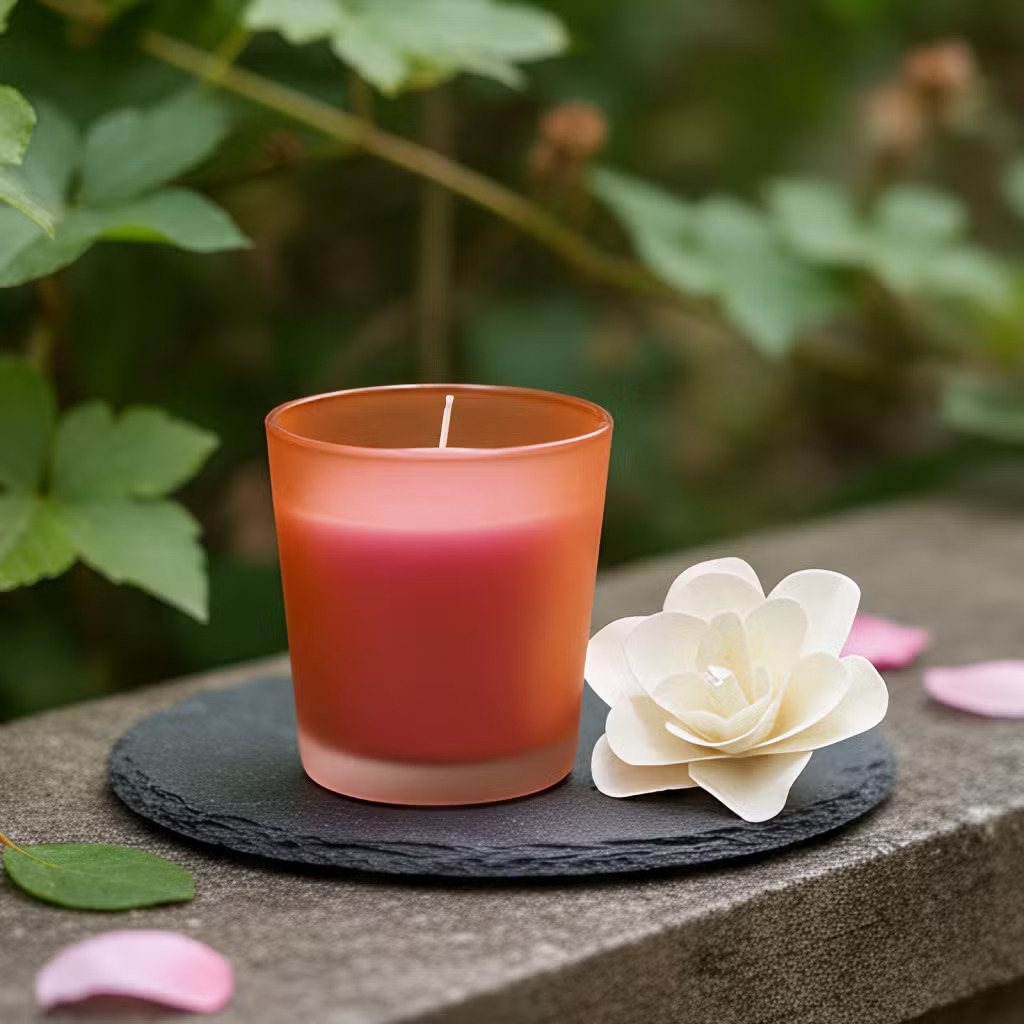
Votive candles are small, short candles designed to burn inside a suitable heat-resistant holder. They are widely used for home decoration, religious ceremonies, meditation, aromatherapy, and ambient lighting.
Unlike pillar candles, which are designed to stand independently, votive candles are generally intended to burn in a holder. During burning, the wax melts into a pool of liquid wax, and the candle typically relies on the holder to contain this melted wax.
Votive candles are popular because of their compact size, simple construction, relatively affordable production, and versatility. They can be manufactured in different colours, fragrances, wax formulations, and shapes to meet decorative, commercial, and ceremonial requirements.
2. What Is a Votive Candle?
A votive candle is a small candle that is commonly cylindrical, with a wick running through its centre. It is designed to burn in a suitable votive holder, which supports the candle and contains the melted wax.
Typical characteristics include:
- Small size and compact shape.
- A centrally positioned wick.
- A relatively short burning time compared with larger candles.
- A design intended for use in a holder.
- Availability in scented and unscented varieties.
- Compatibility with different wax formulations.
Votive candles are often approximately 4–6 cm tall, although actual dimensions vary by manufacturer and intended use. Their burning time depends on the candle’s mass, wax composition, wick, airflow, and holder design.
3. Main Components of a Votive Candle
A votive candle consists of several components that work together to produce a stable flame and controlled wax consumption.
3.1 Wax
Wax forms the main body of the candle and serves as its fuel.
Common wax materials include:
- Paraffin wax.
- Soy wax.
- Beeswax.
- Palm wax.
- Blended vegetable waxes.
- Specialised candle wax blends.
The wax formulation influences hardness, melting behaviour, fragrance retention, colour, shrinkage, and burning performance.
3.2 Wick
The wick transports melted wax from the candle’s surface toward the flame through capillary action. The heat of the flame vaporises the fuel, and the wax vapour burns.
Common wick materials include braided cotton and specially engineered cotton wicks.
Wick size and construction must be matched to the candle diameter, wax formulation, fragrance load, dye, and intended holder. An incorrectly sized wick can cause tunnelling, excessive flame height, soot, or incomplete burning.
3.3 Fragrance
Fragrance is optional and is added to scented votive candles to provide a particular aroma.
Examples include floral, citrus, woody, herbal, and seasonal fragrances.
The fragrance must be suitable for candle-making and compatible with the selected wax. Excessive fragrance loading may cause sweating, poor wax structure, or unstable burning.
3.4 Colouring Agents
Candle dyes may be added to create different colours.
Dyes should be specifically suitable for candle production and used at appropriate concentrations. Excessive dye or incompatible colourants can affect wick performance and flame characteristics.
3.5 Holder
Although the holder is not part of the candle itself, it is essential to the intended use of most votive candles.
A suitable holder:
- Supports the candle upright.
- Contains the liquid wax pool.
- Protects the supporting surface.
- Helps reduce the risk of spilled molten wax.
The holder must be heat-resistant, stable, and appropriate for the candle’s dimensions and burning behaviour.
4. Types of Votive Candles
Votive candles can be classified according to their wax composition, fragrance, appearance, and intended application.
4.1 Paraffin Votive Candles
These candles use paraffin wax, a petroleum-derived wax widely used in commercial candle manufacturing.
Characteristics:
- Generally good mouldability.
- Consistent availability.
- Broad compatibility with candle dyes and suitable fragrances.
- Formulations available across a range of melting characteristics.
They are commonly used for decorative candles, hospitality settings, and large-scale production.
4.2 Soy Votive Candles
Soy votive candles are made using soy-based vegetable wax, sometimes blended with other waxes.
Characteristics:
- Renewable plant-derived feedstock.
- Often softer than traditional paraffin formulations.
- Burning and mould-release performance depend on the specific blend.
- May require careful wick and formulation selection.
A soy formulation designed for containers may not be suitable for a freestanding votive candle without adjustments.
4.3 Beeswax Votive Candles
Beeswax is a naturally produced wax with its own characteristic colour and aroma.
Characteristics:
- Natural honey-like scent.
- Relatively firm structure in many formulations.
- Often more expensive than paraffin.
- May require a wick selected for its particular melting and flow behaviour.
Beeswax votives are frequently used for premium decorative or ceremonial purposes.
4.4 Scented Votive Candles
These candles contain fragrance ingredients intended to release aroma during burning.
Their performance depends on fragrance compatibility, wax formulation, wick selection, and the size and ventilation of the room.
4.5 Unscented Votive Candles
Unscented votives are manufactured without added fragrance.
They are useful in religious settings, restaurants, events, and other environments where additional fragrance may be undesirable.
4.6 Decorative and Coloured Votive Candles
These candles feature specific colours, finishes, or seasonal designs.
They may be produced in single colours, layered colours, or formulations intended to create particular surface effects. Decorative additives must be suitable for candle use and must not introduce combustible hazards.
5. Materials Used in Votive Candle Manufacturing
The selection of raw materials directly affects production efficiency, appearance, and burning quality.
| Material | Purpose | Important consideration |
|---|---|---|
| Candle wax | Main fuel and candle body | Melting behaviour, hardness, shrinkage, and compatibility |
| Cotton wick | Transports liquid wax to the flame | Wick size, braid, and treatment |
| Candle dye | Provides colour | Compatibility and concentration |
| Candle fragrance | Provides scent | Compatibility, safe loading, and stability |
| Wick sustainer or holder | Supports the wick during manufacturing where required | Positioning and suitability for the design |
| Release agent, if used | Helps release the candle from the mould | Must be compatible with the mould and product |
For production, raw materials should be sourced from suppliers that provide suitable technical information and safety documentation.
6. Manufacturing Process of Votive Candles
Votive candles are commonly produced by moulding melted wax around a centrally positioned wick. The precise process depends on the wax formulation, equipment, production volume, and required finish.
Step 1: Preparation of Raw Materials
The wax, wick, dye, fragrance, moulds, and other required materials are prepared.
The moulds should be clean, dry, undamaged, and suitable for the selected wax and process temperature.
Step 2: Melting the Wax
The wax is heated in a suitable melting vessel until it reaches the recommended processing temperature.
Temperature control is important because overheating may degrade the wax or fragrance and may create a fire hazard.
Always follow the wax supplier’s temperature recommendations and use appropriate temperature-monitoring equipment.
Step 3: Adding Colour and Fragrance
Where required, candle dye is added and mixed until evenly distributed.
Fragrance is incorporated at the temperature and concentration recommended by the wax and fragrance suppliers. Excessive fragrance should be avoided because it can negatively affect the candle’s structure and burning behaviour.
Step 4: Wick Preparation
The wick is positioned centrally in the mould and secured so that it remains straight during filling and cooling.
Accurate wick placement helps achieve consistent burning and reduces the risk of uneven wax consumption.
Step 5: Filling the Mould
The prepared liquid wax is poured into the mould at an appropriate temperature.
Pouring temperature, mould temperature, and filling speed influence surface quality, shrinkage, and the formation of air pockets.
Step 6: Cooling and Solidification
The filled mould is allowed to cool under controlled conditions.
During cooling, the wax changes from liquid to solid. Different waxes contract by different amounts, so cooling behaviour must be considered when selecting the mould design and process parameters.
Step 7: Top-Up Filling, if Required
Some wax formulations shrink during solidification and may produce a depression near the wick.
A controlled top-up pour may be needed to produce an even top surface. Whether this step is necessary depends on the wax formulation and moulding process.
Step 8: Demoulding
Once the candle has cooled and solidified sufficiently, it is removed from the mould.
The candle should not be removed prematurely because it may deform, crack, or develop surface damage.
Step 9: Wick Trimming and Finishing
The wick is trimmed to the specified length. The candle is inspected for surface imperfections, correct dimensions, colour consistency, and proper wick positioning.
Step 10: Quality Testing and Packaging
Finished candles are checked against established quality requirements. Representative samples should undergo controlled burn testing before the product is released for sale.
Candles are then packed in suitable packaging that protects them from damage, dust, and excessive heat during storage and transportation.
7. Important Design Considerations for Votive Candles
7.1 Candle Dimensions
Votive dimensions affect wax mass, burning time, mould selection, and holder compatibility.
The diameter and height should be consistent across production batches. The candle must fit the intended holder without becoming unstable or leaving excessive clearance.
7.2 Wick Selection
Wick selection is one of the most important factors in candle performance.
A wick that is too small may cause tunnelling or leave substantial unburned wax. A wick that is too large may create an excessively tall flame, overheating, soot, or rapid fuel consumption.
The wick should be selected through testing with the actual wax, dye, fragrance, and candle dimensions.
7.3 Wax Shrinkage
Wax contracts as it cools. Uneven cooling or excessive shrinkage may create surface depressions, gaps, cracks, or difficulty during demoulding.
Appropriate wax selection, controlled cooling, and suitable pouring conditions help reduce these defects.
7.4 Mould Material
Votive candle moulds may be manufactured from aluminium, steel, silicone, or other materials suitable for candle production.
- Aluminium moulds: Good heat transfer and durability.
- Steel moulds: Useful for robust production tooling and repeated use.
- Silicone moulds: Flexible and often convenient for demoulding.
Mould material affects cooling rate, surface finish, dimensional consistency, maintenance, and production cycle time.
7.5 Surface Finish
The mould surface influences the candle’s appearance after demoulding.
A smooth mould can produce a relatively smooth surface, while mould defects, contamination, and poor cooling may create marks or blemishes.
7.6 Burning Performance
The candle should burn in a stable and predictable manner when used with the intended holder.
Testing should evaluate flame stability, wax-pool development, soot, excessive smoking, holder temperature, and the risk of the flame becoming unstable as the candle burns down.
8. Common Votive Candle Defects and Solutions
| Defect | Possible cause | Recommended solution |
|---|---|---|
| Surface cracks | Rapid or uneven cooling | Adjust cooling conditions and review the wax formulation |
| Sinkholes around the wick | Wax shrinkage during solidification | Optimise pouring temperature and use a suitable top-up process |
| Air bubbles | Poor pouring technique or trapped air | Improve filling conditions and minimise air entrapment |
| Candle sticks in the mould | Inadequate cooling, unsuitable mould surface, or poor release characteristics | Allow sufficient cooling and review mould condition |
| Off-centre wick | Poor wick securing or movement during filling | Improve wick fixtures and positioning |
| Uneven burning | Incorrect wick selection or off-centre wick | Retest wick size and ensure central placement |
| Tunnelling | Wick too small or unsuitable wax-wick combination | Test an appropriate wick and reformulate if necessary |
| Excessive soot | Wick too large, long wick, draughts, or unsuitable formulation | Trim the wick and evaluate wick and formulation choices |
| Weak fragrance | Fragrance incompatibility, poor formulation, or unsuitable fragrance loading | Verify the fragrance and wax specifications and conduct controlled testing |
| Colour variation | Inconsistent dye dispersion or temperature control | Improve mixing and control processing conditions |
A single defect may have multiple causes. Corrective action should be based on controlled trials rather than changing several manufacturing variables simultaneously.
9. Quality Control of Votive Candles
Quality control ensures that candles meet the required appearance, dimensional, and burning standards.
9.1 Visual Inspection
Inspect for:
- Cracks and sinkholes.
- Surface scratches.
- Air pockets.
- Uneven colour.
- Contamination.
- Damaged edges.
- Incorrect wick placement.
9.2 Dimensional Inspection
Measure candle height and diameter to verify consistency and compatibility with the intended holder.
9.3 Weight Inspection
Weigh representative candles to verify that the wax mass is consistent with the product specification.
9.4 Wick Inspection
Check wick position, exposed length, and secure attachment.
9.5 Burn Testing
Burn testing should be conducted under controlled conditions using the specified holder.
Evaluate flame behaviour, wax-pool development, soot, smoke, burning duration, and the temperature of the holder and nearby surfaces. Test samples should be observed throughout the intended burning period, including the final stage of use.
9.6 Packaging Inspection
Check that packaging protects the candle and that any required product information and safety instructions are included.
10. Factors Affecting the Burning Time of Votive Candles
The burning time of a votive candle depends on several interacting factors.
- Wax mass: More wax generally provides more fuel.
- Wax formulation: Different waxes melt and feed the wick at different rates.
- Wick size: An oversized wick may consume fuel more quickly, while an undersized wick may not burn properly.
- Candle dimensions: Diameter and height affect the size and development of the wax pool.
- Fragrance and dye: These ingredients can alter burning behaviour.
- Airflow: Draughts can make the flame flicker and change fuel consumption.
- Holder design: The holder influences heat transfer, wax containment, and burning conditions.
There is no universal burning time for all votive candles. Actual duration should be established through testing of the finished product.
11. Applications of Votive Candles
Votive candles are used in a wide range of settings.
Religious and Ceremonial Uses
They are commonly used in prayer spaces, churches, memorial services, and other ceremonies where small, steady sources of light are required.
Home Decoration
Votive candles provide ambient lighting in living rooms, bedrooms, and decorative displays when placed in suitable holders.
Hospitality and Restaurants
Hotels, restaurants, and event venues use votive candles to create a warm atmosphere on tables and in decorative arrangements.
Meditation and Relaxation
Unscented or lightly scented votive candles may be used during meditation and relaxation activities.
Events and Celebrations
They are used in weddings, seasonal displays, parties, and other events because of their compact size and wide variety of colours and styles.
12. Advantages and Limitations of Votive Candles
| Advantages | Limitations |
|---|---|
| Compact and easy to store | Usually require a suitable holder |
| Suitable for decorative and ceremonial uses | Produce an open flame |
| Available in many colours and fragrances | Can spill molten wax if used incorrectly |
| Relatively simple to manufacture | Burning performance depends on correct wick selection |
| Suitable for batch production | Require quality control and burn testing |
| Can be produced using different wax formulations | Heat and fragrance may affect storage stability |
13. Safety Precautions
Because votive candles produce an open flame and molten wax, safe handling is essential.
- Always burn the candle in a stable, heat-resistant holder designed for votive candles.
- Place the holder on a level, heat-resistant surface.
- Keep candles away from curtains, paper, furniture, and other combustible materials.
- Keep candles away from children, pets, and draughts.
- Never leave a burning candle unattended.
- Keep the wick trimmed according to the product instructions.
- Do not move the candle while the wax is hot or liquid.
- Do not allow debris, matches, or wick trimmings to accumulate in the melted wax.
- Follow the manufacturer’s instructions for maximum burn duration and end-of-life use.
- Extinguish the candle before the flame reaches the holder or the remaining wax becomes insufficient for safe use.
During manufacturing, wax should be heated using suitable equipment with temperature control. Never leave heated wax unattended, and keep it away from ignition sources.
14. Best Practices for Manufacturing High-Quality Votive Candles
- Select wax and wick combinations designed for the intended candle size.
- Use accurate temperature controls during melting and pouring.
- Ensure that the wick remains centred throughout filling and cooling.
- Maintain clean, undamaged moulds.
- Control cooling conditions to minimise cracks and sinkholes.
- Use candle-compatible dyes and fragrances at appropriate concentrations.
- Inspect dimensions, weight, colour, and surface finish.
- Conduct burn testing on the complete finished formulation.
- Store finished candles away from excessive heat and direct sunlight.
- Maintain production records to improve repeatability and identify recurring defects.
15. Conclusion
Votive candles are compact candles widely used for decorative lighting, religious ceremonies, hospitality, and relaxation. Their manufacture involves selecting suitable wax and wick materials, controlling melting and pouring temperatures, positioning the wick accurately, managing cooling, and carrying out quality inspections.
The most important factors affecting their performance are wax formulation, wick selection, candle dimensions, mould quality, and burning conditions.
By maintaining consistent manufacturing practices and conducting appropriate burn testing, manufacturers can produce votive candles with attractive appearance, reliable performance, and improved safety.


