
Pillar Candles
1. Introduction to Pillar Candles
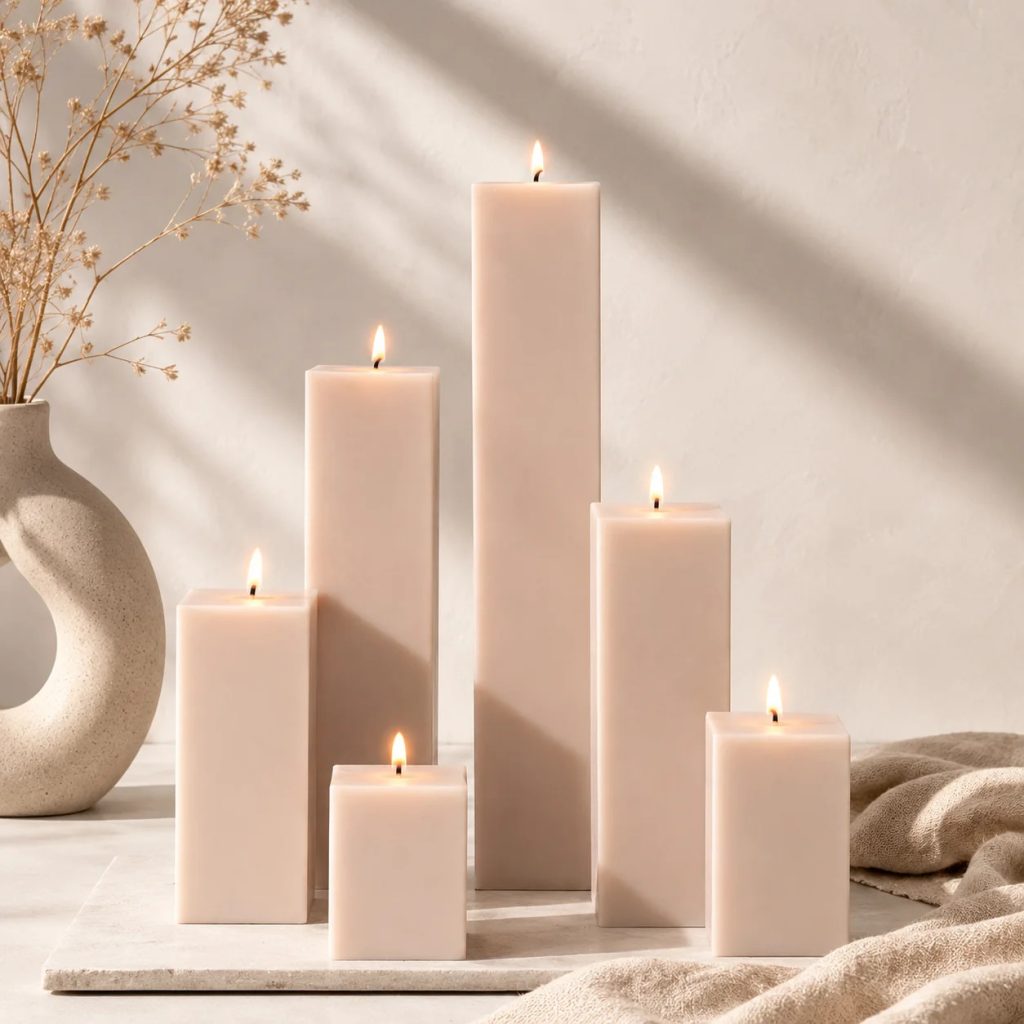
Pillar candles are freestanding candles designed to maintain their shape without requiring a container. They are generally cylindrical, but they can also be square, rectangular, oval, or sculptural, depending on the mould design.
Pillar candles are widely used for home decoration, weddings, festivals, religious ceremonies, restaurants, hotels, spas, and gift products. They are available in various sizes, colours, fragrances, textures, and decorative finishes.
Unlike container candles, which are supported by a glass or metal vessel, pillar candles must have sufficient hardness and structural strength to stand independently during storage and use.
The main characteristics of a good pillar candle are a stable shape, smooth surface, suitable wick, consistent burning performance, and resistance to cracking or deformation.
2. Main Characteristics of Pillar Candles
2.1 Freestanding structure
Pillar candles are designed to stand independently on a flat, heat-resistant surface. Their wax formulation must be firm enough to maintain the candle’s shape at normal room temperatures.
2.2 Different shapes and sizes
Pillar candles can be manufactured in different heights, diameters, and geometric forms. Common shapes include cylindrical, square, rectangular, ribbed, twisted, and decorative sculptural designs.
2.3 Hardness and durability
Pillar candles generally require a harder wax formulation than container candles. Adequate hardness helps prevent bending, surface damage, and deformation during handling and storage.
2.4 Decorative appearance
Pillar candles may have smooth, rustic, marbled, layered, coloured, or textured finishes. The final appearance depends on the wax, dye, mould surface, pouring conditions, and cooling process.
2.5 Controlled burning
A properly designed pillar candle should burn steadily while retaining an appropriate amount of solid wax around the melt pool. Wick selection and wax formulation play important roles in controlling the flame, melting behaviour, and dripping.
3. Materials Used in Pillar Candles
The choice of wax directly affects the candle’s hardness, surface finish, fragrance performance, shrinkage, and burning characteristics.
3.1 Paraffin wax
Paraffin wax is commonly used to manufacture pillar candles because it is versatile and available in different grades.
Advantages
- Suitable for a wide range of mould shapes.
- Can produce smooth surfaces and well-defined details.
- Compatible with many candle dyes and fragrances.
- Available in formulations with different hardness and melting characteristics.
Limitations
- The wrong grade may produce a candle that is too soft or brittle.
- Incorrect cooling can lead to cracks, sinkholes, or surface imperfections.
- Formulation and wick selection must be tested to achieve consistent burning.
Applications: Decorative candles, coloured pillar candles, traditional candles, and commercial candle production.
3.2 Beeswax
Beeswax is a natural wax produced by honeybees. It is often used for premium and traditional pillar candles.
Advantages
- Can produce firm, freestanding candles.
- Has a characteristic natural aroma.
- Naturally ranges from yellow to golden brown, depending on the grade.
- Suitable for simple and decorative candle shapes.
Limitations
- Generally more expensive than paraffin.
- Its natural colour and aroma may affect the final appearance and fragrance.
- Requires appropriate temperature control and wick testing.
Applications: Premium candles, traditional candles, gifts, and decorative products.
3.3 Soy wax
Soy wax is derived from soybean oil. Specially formulated pillar waxes are available for making freestanding candles.
Advantages
- Plant-derived raw material.
- Suitable for coloured and fragranced candles when correctly formulated.
- Attractive to customers seeking plant-based candle products.
Limitations
- Not every soy wax is suitable for pillar candles.
- Some formulations may be softer than required.
- Cooling, shrinkage, and surface appearance can differ from paraffin wax.
Applications: Plant-based decorative candles and selected fragranced pillar candles.
3.4 Palm wax
Palm wax is made from palm oil and can create distinctive crystalline or feather-like patterns.
Advantages
- Certain formulations provide sufficient hardness for freestanding candles.
- Can produce decorative surface effects.
- Suitable for specialised candle designs.
Limitations
- Results depend on formulation and cooling conditions.
- Some grades require more careful process control.
- Environmental considerations depend on responsible sourcing.
Applications: Decorative pillar candles and candles with crystalline surface finishes.
3.5 Blended waxes
Blended waxes combine two or more waxes to achieve a balance of hardness, shrinkage, surface finish, and burning performance.
Blends may be developed to improve:
- Shape retention.
- Mould release.
- Resistance to cracking.
- Fragrance compatibility.
- Surface appearance.
- Burning consistency.
The final blend should always be tested because the properties of a mixture depend on the particular waxes and their proportions.
4. Types of Pillar Candles
4.1 Classic pillar candles
These have simple cylindrical or square shapes with smooth sides. They are suitable for home decoration, events, and everyday decorative arrangements.
4.2 Rustic pillar candles
Rustic pillar candles feature a deliberately textured, weathered, or uneven surface. Their handmade appearance makes them popular for traditional and natural-style décor.
4.3 Layered pillar candles
Layered candles are produced by pouring different coloured wax layers into the mould. The layers may have clear boundaries or gradual colour transitions.
4.4 Marbled pillar candles
Marbled candles feature swirling patterns created by controlled mixing of differently coloured waxes. The technique requires care to prevent the colours from blending into a single uniform shade.
4.5 Sculptural pillar candles
Sculptural candles use specially designed moulds to create shapes such as flowers, geometric forms, twisted columns, ribbed patterns, and other decorative designs.
4.6 Fragranced pillar candles
These candles contain fragrance oil suitable for candle making. The fragrance concentration must follow the wax and fragrance suppliers’ recommendations, and the finished formulation must be burn-tested.
4.7 Unscented pillar candles
Unscented candles contain no intentionally added fragrance. They are often selected for formal events, dining areas, religious ceremonies, and settings where additional fragrance is undesirable.
5. Equipment and Materials Required
The following items are commonly used in pillar candle production.
| Equipment or material | Purpose |
|---|---|
| Pillar candle wax | Forms the candle body |
| Candle mould | Determines the candle’s shape and dimensions |
| Wick | Supplies fuel to the flame |
| Wax melting pot or melter | Melts wax under controlled conditions |
| Thermometer | Monitors wax temperature |
| Digital weighing scale | Measures wax, dye, and fragrance |
| Wick holder or centring tool | Keeps the wick aligned |
| Wick sustainer or base tab, where appropriate | Helps secure the wick |
| Candle dye | Adds colour |
| Candle fragrance oil, if required | Adds scent |
| Pouring jug | Supports controlled pouring |
| Suitable release agent, if specified | Helps release the candle from compatible moulds |
| Heat-resistant work surface | Supports safe production |
Use candle-grade ingredients and equipment suitable for the temperatures involved. A release agent should only be used when compatible with the mould and candle formulation.
6. Step-by-Step Manufacturing Process
Step 1: Calculate and measure the wax
Determine the approximate wax quantity required for the mould. The mould’s volume can provide an initial estimate, but the actual quantity depends on the wax density and candle dimensions.
Weigh the wax before melting so that the formulation remains consistent between batches.
Step 2: Melt the wax
Heat the wax using an appropriate wax melter or controlled heating system. Follow the wax supplier’s recommended melting temperature and avoid overheating.
Different waxes have different melting and processing requirements, so one temperature should not be used for every formulation.
Step 3: Prepare the mould
Clean and dry the mould before use. Install the wick through the appropriate wick opening and secure it so that it remains straight and centred.
Check that the mould is properly assembled and does not leak. The mould should be compatible with the wax temperature and production method.
Step 4: Add colour and fragrance
If a coloured candle is required, add a compatible candle dye according to its instructions. Mix thoroughly to distribute the colour evenly.
If fragrance is required, add a candle-compatible fragrance oil at the supplier-recommended temperature and concentration. Mix gently and avoid unnecessary agitation that can introduce air bubbles.
Step 5: Pour the wax
Pour the prepared wax into the mould at the recommended pouring temperature.
Pour steadily to minimise splashing and air entrapment. The correct pouring temperature depends on the wax formulation, mould material, candle dimensions, and desired finish.
Step 6: Allow the candle to cool
Leave the candle to cool under controlled conditions. Rapid or uneven cooling can contribute to cracks, shrinkage defects, or poor surface appearance.
Some waxes shrink as they solidify, creating a depression near the wick. If the formulation requires it, a controlled top-up pour can be used to fill the depression.
Step 7: Remove the candle from the mould
Allow the candle to cool sufficiently and become firm before demoulding.
Remove it carefully to avoid scratches, cracks, or deformation. If the candle does not release easily, check the mould surface, cooling time, and wax formulation rather than forcing it out.
Step 8: Trim the wick and finish the candle
Trim the wick to the length specified by the candle design or applicable safety guidance. Remove minor surface imperfections if necessary and ensure the base is stable.
For layered, marbled, or sculptural candles, inspect the decorative details to ensure that the final product meets the intended design.
Step 9: Inspect and package
Check the candle’s dimensions, colour, surface finish, wick alignment, and structural condition.
Allow the candle to stabilise as appropriate for its formulation before packaging. Protect finished candles from excessive heat, dust, scratches, and direct sunlight during storage.
7. Selecting the Correct Wick
Wick selection is one of the most important factors in pillar candle manufacturing.
A wick that is too small may produce a weak flame, poor melt-pool development, or tunnelling. A wick that is too large may cause an excessively high flame, rapid melting, smoking, or soot formation.
Wick selection depends on:
- Candle diameter and shape.
- Wax type and formulation.
- Fragrance concentration.
- Colourants and other additives.
- Wick material, series, and construction.
- Desired flame and melting behaviour.
A wick suitable for one wax formulation may not perform well in another, even when both candles have the same diameter.
Always test the complete candle formulation, including its wax, wick, fragrance, dye, and dimensions, before producing candles for sale.
8. Common Pillar Candle Defects and Their Solutions
| Defect | Possible cause | Recommended solution |
|---|---|---|
| Sinkhole near the wick | Wax shrinkage during cooling | Adjust cooling conditions and use a controlled top-up pour if required |
| Cracks in the candle | Rapid cooling, temperature variation, or unsuitable wax | Review the formulation and cooling process |
| Rough surface | Incorrect pouring temperature, mould contamination, or uneven cooling | Clean the mould and optimise process temperatures |
| Air bubbles | Air trapped during mixing or pouring | Pour carefully and minimise unnecessary agitation |
| Candle sticks in the mould | Insufficient shrinkage, mould damage, or premature demoulding | Check mould condition and allow adequate cooling |
| Uneven colour | Poor dye dispersion or inconsistent mixing | Use compatible dye and mix thoroughly |
| Off-centre wick | Inadequate wick support during pouring | Secure the wick before filling the mould |
| Tunnelling during burning | Incorrect wick size or unsuitable candle formulation | Evaluate wick selection and perform burn tests |
| Excessive dripping | Wax formulation, wick, candle geometry, or airflow | Review the design and test the finished candle |
| Soft or deformed candle | Unsuitable wax grade or storage at excessive temperatures | Select a suitable pillar wax and store under appropriate conditions |
9. Quality Control of Pillar Candles
Quality control helps ensure that each candle is consistent, attractive, and suitable for its intended use.
9.1 Visual inspection
Check for cracks, air pockets, discolouration, rough surfaces, sinkholes, and damage from demoulding.
9.2 Dimensional inspection
Measure the candle’s height, diameter, and other important dimensions. Consistent dimensions help maintain product appearance and repeatable burning performance.
9.3 Wick inspection
Confirm that the wick is straight, correctly positioned, and securely installed.
9.4 Structural inspection
Check whether the candle stands securely and maintains its shape under normal storage conditions.
9.5 Burn testing
Burn-test representative samples under controlled conditions. Evaluate flame stability, melt-pool development, dripping, smoking, soot, and overall candle performance.
9.6 Packaging inspection
Ensure the candle is protected from dust, scratches, heat, and deformation during storage and transport.
10. Factors Affecting Pillar Candle Quality
Several manufacturing variables influence the finished product.
Wax formulation: Determines hardness, shrinkage, surface finish, and burning behaviour.
Pouring temperature: Influences mould filling, surface quality, and solidification.
Mould material: Affects heat transfer, cooling rate, dimensional accuracy, and demoulding.
Cooling conditions: Influence cracking, sinkholes, and surface consistency.
Wick selection: Determines flame characteristics and the rate at which wax is consumed.
Fragrance and dye: Can change the physical and burning properties of the wax formulation.
Storage conditions: Excessive heat or direct sunlight can cause softening, colour changes, or deformation.
For consistent production, record the formulation, wax batch, temperatures, cooling conditions, wick type, and inspection results for each production run.
11. Applications of Pillar Candles
Pillar candles are used in a wide range of settings.
- Home décor: Decorative arrangements for tables, shelves, and living spaces.
- Weddings and events: Centrepieces and decorative displays.
- Hotels and restaurants: Ambient lighting and interior decoration.
- Religious ceremonies: Traditional and ceremonial candle use.
- Festivals and holidays: Seasonal decorations and gifts.
- Retail and gifting: Premium candle collections and gift sets.
- Spas and wellness settings: Decorative ambience, where suitable fire-safety precautions are followed.
12. Safety Precautions
- Never leave melting wax unattended.
- Use controlled heating equipment and avoid heating wax over an uncontrolled flame.
- Keep water away from molten wax to prevent dangerous splashing.
- Follow supplier instructions and safety data sheets for fragrance oils, dyes, and additives.
- Provide appropriate ventilation when required.
- Keep finished candles away from children, pets, curtains, and other combustible materials.
- Burn candles on stable, heat-resistant surfaces and never leave a burning candle unattended.
- Test the finished candle formulation before commercial sale.
Conclusion
Pillar candles are versatile, freestanding candles valued for their durability, decorative appearance, and variety of shapes, colours, and finishes. Successful manufacturing depends on choosing a suitable pillar wax, selecting the correct wick, preparing the mould properly, controlling pouring and cooling, and carrying out thorough quality checks.
The key to producing high-quality pillar candles is to ensure that each candle maintains its shape, releases cleanly from the mould, has an attractive finish, and burns safely and consistently.


